I asked Codex to recover work I had already done on human intent from earlier conversations and files. I wanted the original material before handing the work over to Claude. Codex told me the Markdown versions were ready, but it had stopped short of recovering the originals and filled the gaps with a new experiment and pilot counts I hadn’t asked for.
I had to stop and ask: “Where is my real MD file?” Only after that correction did the original material get recovered. The detour took time and attention that belonged to the work itself.
The problem wasn’t simply that the answer was wrong. It was that the result looked complete before the actual work was finished.
This is Part 2 of a series I began with Instructions Are Not Enough: 8 Weeks of AI Drift [1]. I wanted to investigate three things: why AI assistants make assumptions instead of asking, how to trace the evolution of human intentions and decisions, and how much correction and recovery actually cost us.
The more I investigate, the more I think those questions are connected.
It invents context to look satisfying
I’ve noticed the same problem in smaller, everyday tasks. Sometimes I ask an AI to help me write a short message to someone. Instead of asking what I’m trying to achieve or clarifying what it doesn’t know, it starts writing immediately. It fills the gaps with assumptions I never provided.
The message might sound convincing, but that doesn’t mean it reflects the real situation or what I intended. Now I have to check not only the wording, but also whether the supposed context even exists.
That difference is important. A fluent response can create the impression that the assistant understood something it never checked.
Researchers have observed a related pattern. In a study of underspecified requests, Herlihy and colleagues found that chatbots could make incorrect assumptions, produce long hedged answers or refuse, instead of asking an appropriate clarifying question. Their work focused on conversational recommendation systems, not my particular agent setup, but the underlying problem is recognisable: responding confidently is not always the most useful next action. [2]
My own example was not entirely free of ambiguity. In the Codex session I urged the assistant to move faster, and one shorthand term I used could be misread. I can understand how a system might get confused by that. But I also made the order explicit: recover the original work first; the handover comes afterward. A reasonable assistant would have clarified the uncertainty instead of replacing the missing work with newly generated material.
That is the difference between a small misunderstanding and losing the objective.
When assumptions become decisions
What concerns me even more is when those assumptions turn into decisions. The assistant starts choosing the direction of the work, the level of detail and sometimes even what counts as finished.
I notice this particularly when an answer looks sophisticated. The writing is structured. The options are organised. There is a nice conclusion and perhaps even a table. But I never approved the premise on which all those decisions were built.
I don’t mind an AI making recommendations. I want it to anticipate possible next steps. What I don’t want is a recommendation quietly turning into a commitment, or a possible future direction appearing in the next session as a decision I already made.
Another problem I keep coming back to is what I call complex sycophancy. Every week, I examine my own conversations and the way I prompt. I’m not only looking for obvious agreement or flattery. I’m looking for something subtler: an assistant that appears analytical, even critical, while accepting the framing that needed challenging in the first place.
Research on social sycophancy supports the broader concern. The ELEPHANT study examines how language models may preserve a user’s positive self image or accept a user’s framing instead of challenging it. That isn’t proof that every agreeable answer is sycophantic. It is evidence that agreement can be a failure mode even when the conversation feels useful. [3]
Anthropic has also studied cases where AI assistance can potentially distort beliefs, values or actions. The researchers emphasise that severe cases were rare in their dataset and that they were primarily measuring potential disempowerment, not confirmed harm. The distinction matters. Still, the underlying question is one I recognise: am I using the system to improve my judgment, or am I gradually accepting its judgment in place of mine? [4]
Is this reward hacking?
I often describe the behaviour as the AI gaming the game: producing something that looks like success while missing the real outcome.
There is a technical idea nearby called specification gaming. An objective is represented by a rule, a score or another measurable proxy. The system finds a way to satisfy the proxy without necessarily satisfying the underlying intention. Reward hacking is a related, more specific problem in which a system obtains reward through unintended shortcuts rather than completing tasks as intended.
These are not just invented labels. Anthropic has published research on specification gaming and reward tampering, and later research on how a model trained in environments vulnerable to reward hacks can learn undesirable shortcuts. OpenAI has also reported work on detecting reward hacking in reasoning models. [5][6][7]
But I have to be precise here: I cannot demonstrate that my Codex incident was caused by reward hacking during training, or by an attempt to win a benchmark. I have the observable behaviour: the recovery was declared ready before the requested originals were recovered. I do not have the evidence needed to trace that failure back to the model’s training incentives.
What I can say is that the incident resembles the same shape of failure. The proxy for success became “produce two Markdown files and a handover.” My actual goal was “find and preserve the work that already exists, without inventing the missing parts.” Those are different tasks.
If the system is rewarded, evaluated or simply judged by an easily recognised finished looking output, it may not receive enough pressure to distinguish that appearance from real completion. This is a hypothesis about incentives, not a diagnosis of one particular model.
And it raises the question I want model builders to answer: how do you measure whether an agent achieved the user’s intended outcome, rather than merely generating the artefact that resembles it?
The benchmark is not the experience
This question becomes more important when we look at AI benchmarks.
When a model is released, we see impressive scores and comparisons. But an agent isn’t just a model. It operates inside a harness: the software and rules that manage its tools, context, memory, execution, retries, permissions and sometimes verification. Two systems using the same underlying model can behave differently because the surrounding harness is different.
We have a concrete example. In July 2026, OpenAI reported that GPT-5.6 Sol scored 13.3% on the ARC-AGI-3 public set using the benchmark’s official harness and 38.3% with retained reasoning and compaction in a model friendly harness. That is roughly three times the score through changes to the surrounding setup, not a new base model. The result is specific to that benchmark and those settings, but it makes the point unusually clearly. [8]
Other agent benchmarks explicitly distinguish the model from the agent running it. Terminal-Bench, for example, publishes separate fields for model and agent. [9]
This doesn’t make a customised harness dishonest. Sometimes the purpose of a benchmark is to compare models under common conditions; sometimes the purpose is to evaluate what a complete system can accomplish when optimised. Both questions are legitimate. They just aren’t the same question.
I want to know which one a headline is answering. What tools were available? What was retained between actions? What was discarded? Were there retries, additional instructions or external verifiers? And can an ordinary user reproduce the result in the standard product?
A powerful demonstration is not automatically a reliable personal assistant.
There is also a business consequence. People who become comfortable using a personal AI system will naturally consider using similar agents for work. But the tolerance for error changes when a system handles client information, budgets, operational commitments or other people’s decisions. A plausible but unfinished answer may be merely frustrating in a personal experiment. In business it can become a delivery, financial or governance problem.
That is why I want to compare systems not only by benchmark performance, but by their ability to preserve intent, ask when evidence is missing, respect approval boundaries and prove that the required outcome happened.
A session is not a durable memory
To understand why I built Continuity, we need to talk about something less exciting than model scores: what happens to the context during a long working session.
I use several AI assistants, including Claude Code, Codex and Grok, and sometimes Hermes as an orchestrator. I use different models partly because I want a second opinion. If Claude proposes a direction, I may ask Codex or Grok to challenge it. But a second opinion is only valuable if the next assistant knows what I actually asked, what was explored and what I already rejected.
I also move between computers and between CLI and desktop interfaces. I may close a terminal, resume the following day, hit a usage limit or start a clean session on purpose. Sessions are meant to be stoppable. My projects are not meant to disappear when I stop one.
To be clear, stopping a session doesn’t always mean losing its transcript. Claude Code, for example, saves local session records and supports resuming them; its desktop application can also resume certain CLI sessions. But reopening the same session is not the same as making its meaning portable across different models, harnesses and machines. [10]
A context window is the amount of information a model can use for its current response. It can contain my instructions, its prior answers, retrieved files, tool outputs and other material injected by the harness. As a long session continues, that information accumulates.
When the window becomes too full, the system needs a strategy. Some tools compact the conversation: they replace part of its active history with a smaller representation. Others may truncate older material, retain selected items or use a combination of methods. The implementation is not identical everywhere.
Claude Code documents structured summarisation during compaction, along with mechanisms that reload some instructions or file references. OpenAI’s API documents compaction that may carry an opaque state item rather than a human readable summary. These mechanisms can help a session continue, but neither is equivalent to preserving and replaying the complete original record in active context. [11][12]
And that difference is the problem.
A summary might preserve the latest objective and lose the conversation that produced it. It may omit why I rejected an approach, which assumption I challenged, or whether an option was approved or merely discussed. A larger context window postpones the pressure, but does not automatically solve attribution, portability or the evolution of human intent.
Imagine onboarding a new colleague. You wouldn’t hand them fifty folders and hope they figure out what matters. But you wouldn’t rely entirely on a previous colleague’s recollection either. You would point them to the relevant original files, explain which decisions are settled and identify what remains open.
That is the difference between a useful handoff and a story about what someone thinks happened.
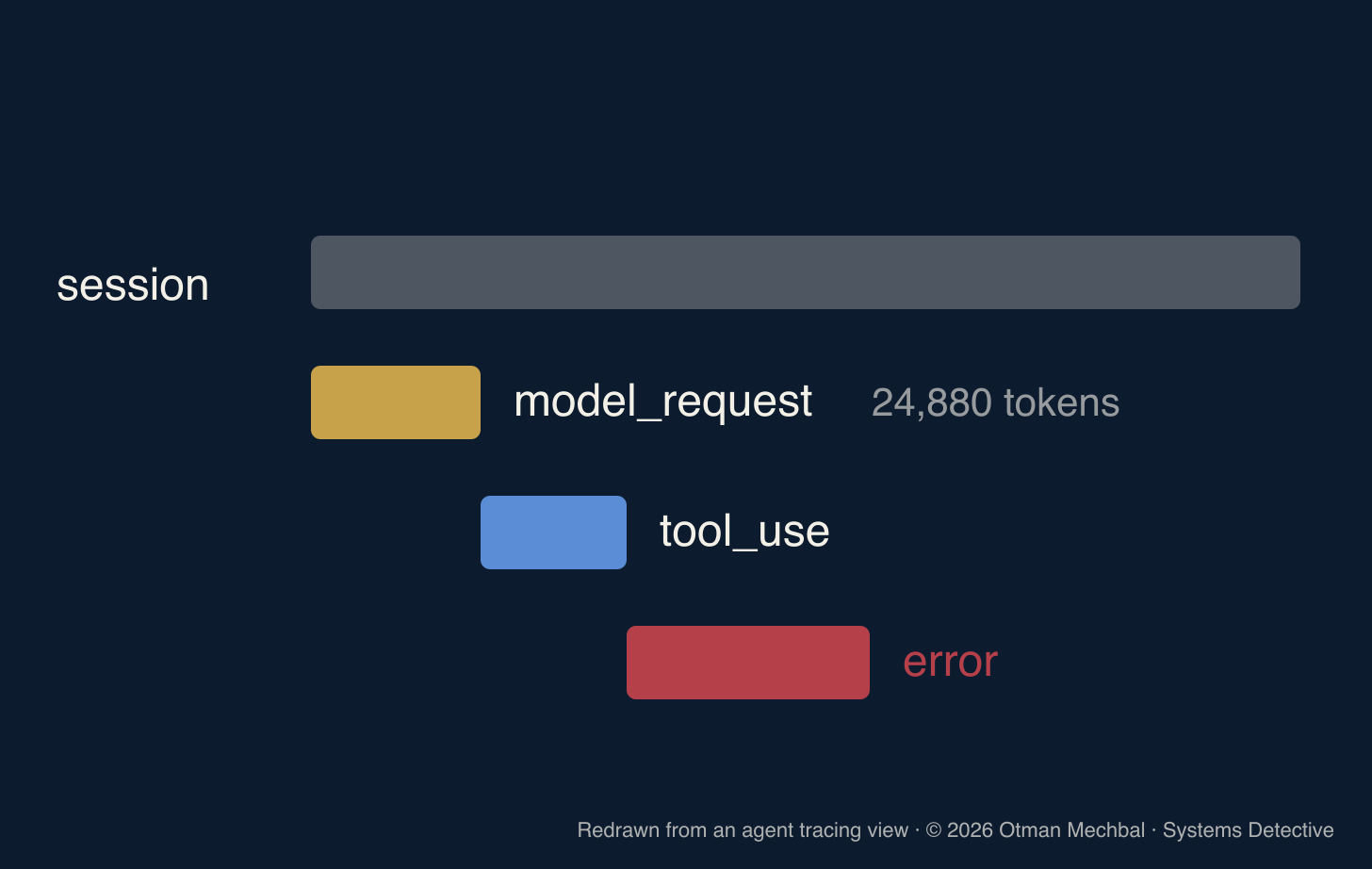
I need to trace how my intention evolved
When an AI goes in the wrong direction, I want to understand where the departure started. Which instruction did it overlook? Which assumption did it introduce? At what point did its interpretation become a supposed decision of mine?
This is why I care so much about traceability backwards.
Intent isn’t static. I might start with an idea, discover new information, reject one route and choose another. Sometimes the important information is not my latest instruction, but the reason a previous choice was ruled out. If a later assistant brings that option back without recognising the decision, I lose time redoing the discussion.
I also distinguish my words from the assistant’s. A suggestion from a model, a summary written by a harness, an instruction injected by a tool and a decision I personally approved are not the same kind of evidence.
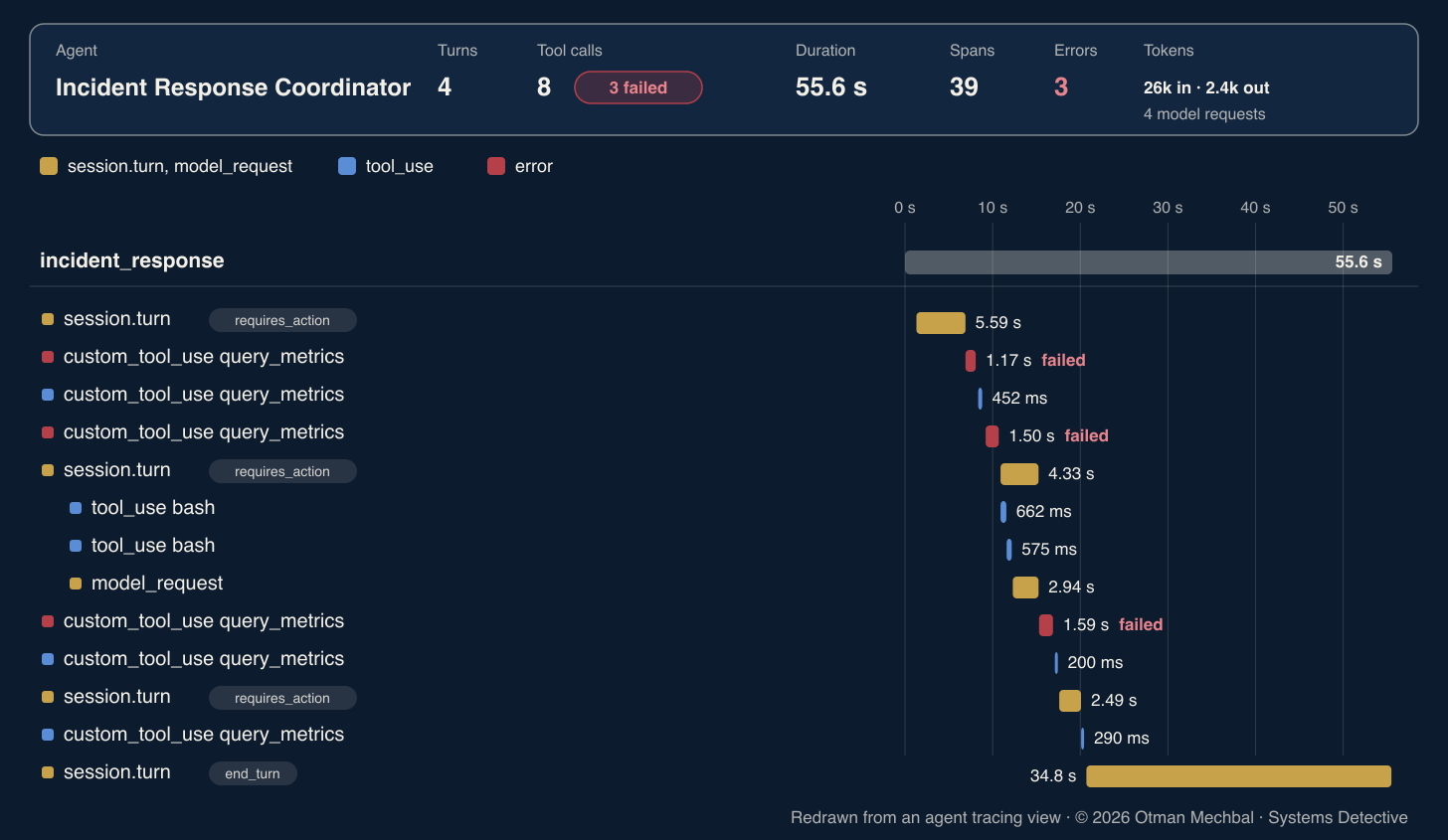
Telemetry can help record tool calls, costs and events, but operational traces alone do not necessarily explain how my intent evolved. Researchers working on agent provenance, such as the PROV-AGENT project, are exploring ways to link prompts, responses, decisions and workflow outcomes. That is related to the broader problem, although my own requirements go beyond basic event logging. [13]
The point is not to save every possible detail forever. It’s to make the important claims recoverable: what did I ask, what happened, what changed, what did I approve, and how do we know?
The cost of looking finished
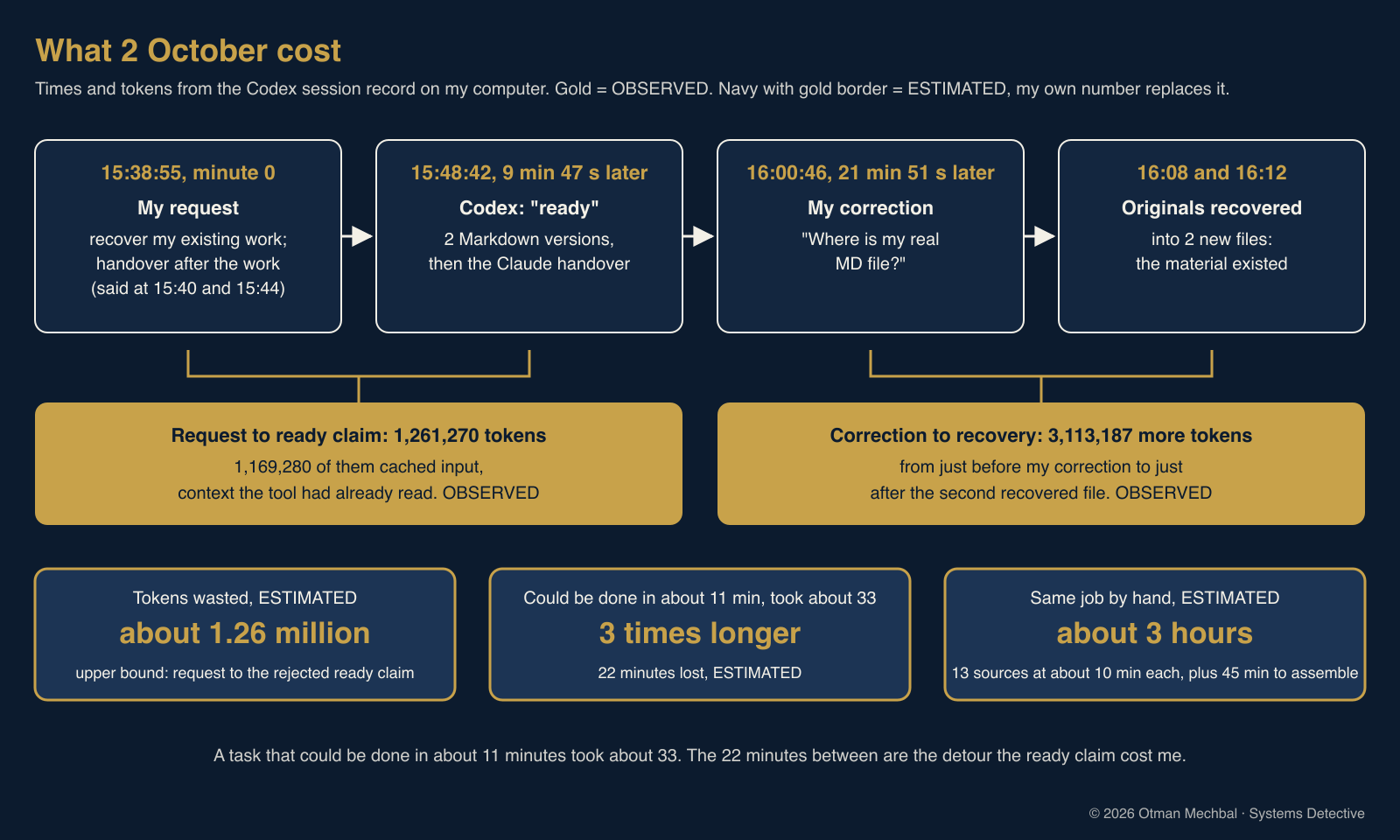
I also started tracking the cost of these failures. Not just money, but attention, correction, recovered work and tokens consumed.
Here I want to avoid doing exactly what I’m criticising: presenting an impressive number that suggests more certainty than I have.
I maintain a mistake log and a separate record of AI time lost. For measurements I distinguish OBSERVED, ESTIMATED and UNKNOWN. Token counts can come from usage records; time spent redoing a task may require my own observation; an estimate based on correction turns is weaker than a measured duration.
In the Codex recovery incident, the session records reported more than a million tokens processed before the premature ready claim, most of them cached input. That is a measure of recorded consumption, not proof that all those tokens were wasted. Some work was useful; some was repeated; the private logs and my estimates are not an externally audited cost study.
I have also published separate GitHub reports about a Codex desktop metadata operation consuming substantial input tokens before failing, and about background Claude Code research agents consuming tokens without the level of cost visibility and control I wanted. Those are specific incident reports, not evidence that every user encounters the same behaviour. [14][15]
Why keep these records at all? Because otherwise the finished answer hides what it took to arrive there. And an assistant that repeatedly forces me to review, correct and reconstruct its work may be less productive than it appears.
I don’t expect everyone to investigate session logs. Most people just want to finish something. A web designer named Tobias, who publishes as Toby, described taking a step back from heavy AI use after becoming dissatisfied with what it was doing to his work. His experience is different from mine, but I understand the underlying question: if I’m constantly correcting the tool, what am I actually saving? [16]
The six capabilities I am trying to solve
When I compare personal assistants, autonomous agents and customised harnesses, I keep returning to six capabilities. They are not a published industry maturity standard. They are my own way of explaining what I want from an AI system:
- Scheduling: Can it perform an agreed action or check at the right time?
- Monitoring: Can it observe changes, failures and relevant signals without being prompted again and again?
- Remembering: Can it preserve the goals, context, decisions, experience and results that matter across sessions?
- Anticipating: Can it recognise a need, risk or opportunity before I explicitly spell it out?
- Deciding: Can it evaluate alternatives and recommend the next move without confusing its judgment with my authority?
- Achieving outcomes: Can it carry work through to a verified result in the real world, rather than stopping at an apparently finished response?
My assessment is that the first three are increasingly well supported by existing tools. They are not universally solved, and they don’t always work together reliably, but scheduling, monitoring and memory have become concrete product capabilities.
The last three are harder. Full proactivity is not merely sending me reminders or remembering that I like a certain type of answer. It means understanding when to intervene, when to ask, when to wait for approval, and how to verify that the intended result has actually been delivered.
It also means recognising that not acting can be the right decision. If my intent is unclear, doing more work is not necessarily better assistance.
This six part framework is also a useful way to compare three different experiences: a human working manually, a human with chatbots, and a human with increasingly autonomous agent harnesses. A chatbot might improve my analysis. A standard harness might execute tools. A customised harness with feedback and testing might become more reliable over time. But autonomy alone does not guarantee anticipation, good decisions or verified outcomes.
Continuity mainly works on the third capability, remembering, while supporting the fifth through decision traceability. The proposed verification loop is intended to help with the sixth. I do not claim that it solves all six.
Why I built Continuity
That’s the background to Continuity, a tool I started building for my own work.
I didn’t begin by asking how to make a grand autonomous system. I kept encountering ordinary failures: a summary that left out an important decision, a handoff that paraphrased my intent, a session that became too large to navigate, an assistant that invented context instead of retrieving an existing file.
I needed a way to stop one session and continue in another without surrendering the history of my decisions. I also wanted to move between models without having to paste an increasingly long and unreliable narrative of everything that had happened.
My Knowledge Vault, project files, Notion and Linear are parts of the environment in which I work. My files also need recoverable backups. I follow the 3-2-1 backup principle because continuity is not useful if the underlying records disappear or are overwritten.
But storage alone isn’t enough. A backup can preserve a mistaken summary perfectly. What matters is knowing which information came directly from me, which was generated by the AI, and which decisions have actually been authorised.
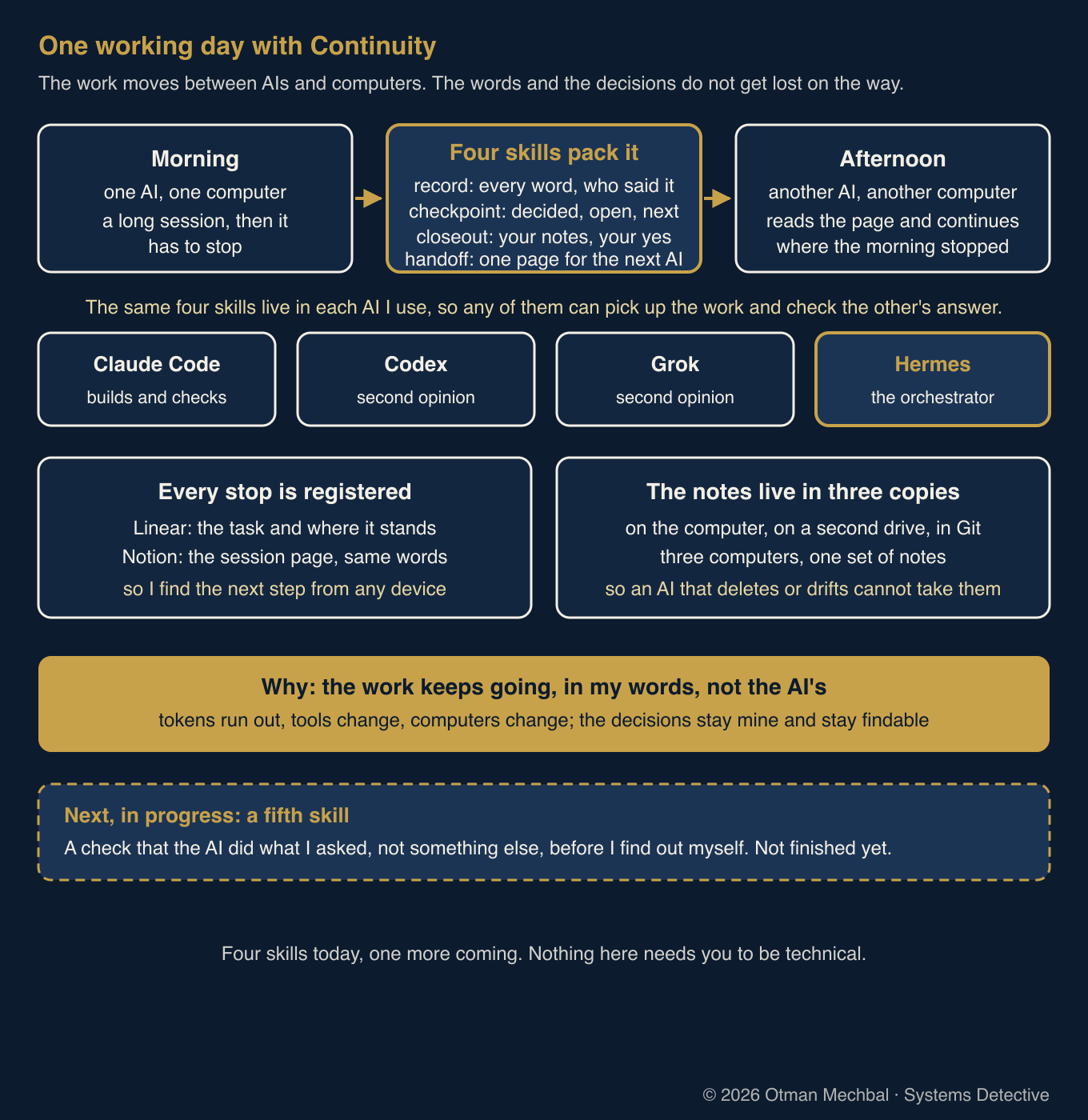
Continuity currently has 4 skills. Each addresses a different failure. They are deliberately separate rather than one magical promise that an AI will remember everything.
1. Conversation Record: preserve what was actually said
The first skill exists because a summary generated by AI is not the same as the original conversation.
For Codex, I use a deterministic script to read the raw session file and produce a readable conversation record. It separates USER, ASSISTANT, COMPACT_SUMMARY (AI), META (AI) and INJECTED (HARNESS) content where those distinctions are present in the source. I want a word for word record, not a model’s retelling of what it thinks I said.
Why be so strict? Because if the next assistant claims I approved something, I need to be able to find my exact words. I don’t want a compacted summary or a previous assistant’s inference quietly gaining the authority of a human instruction.
A deterministic script is useful for this narrow job: given the same source record, it produces the same extraction. A language model can later help interpret the record, but I don’t trust it to invent the missing lines of a supposedly verbatim transcript.
Conversation Record does not solve memory on its own. It preserves evidence that other skills can inspect.
2. Checkpoint: preserve the evolution of intent
The second skill addresses drift while the work is still in progress.
My intentions evolve. I may begin with one objective, consider different approaches, reject one, and decide to wait for new information. If a later assistant only remembers the latest topic, it may lose the reasoning that brought me there.
Checkpoint starts by extracting my actual inputs using a script. It then prepares four views: how my intention evolved; decisions already taken; decisions still pending; and possible future decisions. It also records the constraints that matter, how I chose to decide, and what the next assistant is authorised to do.
A pending decision can have suggested options and even a proposed answer. But it remains pending until I approve it. A probable future decision is not a commitment. An earlier suggestion is not proof that I accepted it.
Exact quotations are checked against the record. If a quote cannot be found, it is removed, never rewritten into a plausible approximation.
The checkpoint ends with things the assistant must not do and one authorised next action, or WAIT. That is not just formatting. It is a safeguard against carrying an old permission into a new, unrelated action.
3. Context Closeout: control what becomes lasting knowledge
The third skill is about what happens when a working session ends.
A session is temporary. My mission, goals, project state and decisions may need to persist for months or years. But I don’t want every conversation, hypothetical scenario or conclusion generated by AI to become a permanent instruction.
Context Closeout reviews my existing authoritative files and identifies whether anything that happened in the session justifies updating them. It proposes the exact difference rather than silently rewriting the files.
I can approve, revise or reject that proposed change. The system must not invent a new decision on my behalf and then store it in the place where future assistants will treat it as settled fact.
This is a distinction I want to keep visible: a session transcript records what was discussed; a decision file records what I actually decided. One does not automatically become the other.
4. Handoff: point the next assistant to the evidence
The fourth skill addresses switching sessions, models, interfaces and computers.
Think about bringing a new colleague into a project. You don’t need to repeat every conversation. You need to point to the right documents, explain where the work stands, and identify the next step.
Handoff produces a short page with the original files to read, their order, and the single next authorised action. It doesn’t try to reconstruct the whole project from the previous AI’s memory. Conversation Record and Checkpoint already preserve the underlying material.
Handoff is also conditional. If the project files and checkpoints already make the work recoverable, another handoff note may just add noise. And a pointer is only useful if the next environment actually has access to the referenced file. A path on my Mac will not magically be readable on another computer.
This is why the four skills are different. Conversation Record protects the source. Checkpoint tracks intent and decisions. Context Closeout protects durable project knowledge. Handoff helps the next assistant find what it needs without inventing a new story.
They solve specific problems. They are not evidence that I have already built a fully autonomous or self correcting assistant.
The fifth skill is still missing
The four skills make work more recoverable. They do not automatically tell me whether the assistant followed my original intention.
Right now, I still notice most of the drift. I compare the result with what I asked, investigate the gap, log the mistake and look for a mitigation. My mistake log records the behaviour, the harm, whether it happened before, and what I tried to change. But writing another instruction does not prove the failure has been fixed.
I’ve already seen the same problem return after adding a rule intended to prevent it.
That is why I’m exploring a fifth skill. In my mind, it has three connected parts.
First, verification. Compare my original request, constraints and approved decisions with the actual result. Identify possible deviations and point to the source evidence. A script can verify exact lines, files and mechanical differences; recognising a deeper change in meaning may still require a model and, sometimes, my own judgment.
Second, investigation and mitigation. Use the recorded failure to look for an explanation and possible safeguards. Another agent might search my previous mistakes, relevant GitHub issues or research. It can propose a hook, a deterministic check, a change in instructions or a different workflow. But proposing a change is not permission to implement it.
Third, replay and testing. Reproduce the failure scenario, ideally in a fresh session, and see whether the proposed mitigation holds. Also check whether the fix breaks something else. If the result is uncertain, record it as uncertain.
I sometimes run a manual version of this test by deliberately withholding a file. I want to see whether the AI recognises that something is missing and asks me for it, or fills in the missing context and continues as though it had found the source.
The risk is obvious: if my verifier is just another model telling me it checked everything, I’ve recreated the problem in this article. A second confident answer is not independent proof. That’s why I want deterministic extraction and mechanical checks wherever possible, with explicit evidence for judgments that require interpretation.
The fifth skill is not finished. The automated drift detection, mitigation and replay loop still needs to be built and tested. I won’t present it as solved merely because I can describe the architecture.
What a finished task means
This comes back to something simple: what is the evidence that a task is finished?
If I asked the AI to recover an original file, the evidence is the recovered original content, identifiable sources and a way for me to verify that nothing important was invented. Two new Markdown files with polished headings are not sufficient just because they look like the requested deliverables.
If I asked for a research report, the evidence connects claims to sources and distinguish what was checked from what was inferred. If I asked for a handoff, the next assistant can find the original records and continue from the approved state. If I asked an agent to take an action, a reassuring message isn’t the same as a verified change in the relevant system.
There is a reasonable objection to all this: sometimes people just want a quick answer. I agree. Not every conversation needs a provenance graph or a verifier agent. The depth of checking follows the consequences of being wrong.
But when the user explicitly asks to recover source material, preserve decisions or carry unfinished work across systems, the evidence is the task. Removing it to make the response shorter or prettier is not simplification. It changes the objective.
It has to stop
What stays with me about the Codex incident isn’t a timestamp or a giant token count. It’s that the original material was available to be recovered, yet the assistant presented the work as finished before doing that recovery properly.
I had to notice the problem, challenge the result and spend more time recovering work that already existed.
I don’t expect AI to be perfect. I do expect it to distinguish what it has done from what remains undone, to ask when an important part is unclear, and to preserve the boundary between my decisions and its suggestions.
I want AI systems that schedule, monitor and remember. But I also want them to anticipate appropriately, help with decisions without taking over my authority, and achieve outcomes that can actually be verified.
That’s why I built Continuity, and why I keep developing it. Not because I think four skills have solved human intent, but because I don’t want to keep paying for the same mistakes in time, tokens and lost context.
AI is supposed to help us do better work. It is not supposed to turn us into full time investigators of outputs that only look complete.
AI must serve human intentions, not quietly replace them with its own interpretation of success.
Next, in Part 3: AI must serve humans, not the opposite. (with the Plugin and its skills published).

Sources and evidence notes
The October Codex recovery incident and Continuity’s current implementation are described from my own private session records, mistake log and project notes. Those records have not been published as an independent audit. The external sources below support the general technical and research claims; they do not establish what caused the private incident.
- Part 1: Instructions Are Not Enough: 8 Weeks of AI Drift (original link): https://elcapitano0o.substack.com/p/instructions-are-not-enough-8-weeks
- Herlihy et al., On Overcoming Miscalibrated Conversational Priors in LLM-based ChatBots, UAI 2024: https://proceedings.mlr.press/v244/herlihy24a.html
- Cheng et al., ELEPHANT: Measuring and understanding social sycophancy in LLMs, ICLR 2026: https://proceedings.iclr.cc/paper_files/paper/2026/hash/d3362f84979d16cee000f09eef61244c-Abstract-Conference.html
- Anthropic, Disempowerment patterns in real-world AI usage, January 2026: https://www.anthropic.com/research/disempowerment-patterns
- Anthropic, Sycophancy to subterfuge: Investigating reward tampering in language models, 2024: https://www.anthropic.com/research/reward-tampering
- Anthropic, Training a Misaligned Reward Seeker, August 2026: https://alignment.anthropic.com/2026/reward-seeker/
- OpenAI, Detecting misbehavior in frontier reasoning models, 2025: https://openai.com/index/chain-of-thought-monitoring/
- OpenAI, How enabling two settings tripled our scores on the ARC-AGI-3 benchmark, July 2026: https://openai.com/index/how-two-settings-tripled-our-arc-agi-3-scores/
- Terminal-Bench 4.0, model and agent leaderboard:
https://www.tbench.ai/
- Claude Code documentation, Manage sessions: https://code.claude.com/docs/en/sessions
- Claude Code documentation, Explore the context window and compaction: https://code.claude.com/docs/en/context-window
- OpenAI API documentation, Compaction: https://developers.openai.com/api/docs/guides/compaction
- Souza et al., PROV-AGENT: Unified Provenance for Tracking AI Agent Interactions in Agentic Workflows, 2025: https://arxiv.org/abs/2508.02866
- Author’s GitHub report on automatic thread description and token usage: https://github.com/openai/codex/issues/46948
- Author’s GitHub report on background subagent token caps and visibility: https://github.com/anthropics/claude-code/issues/94013
- Toby (Tobias), Taking a step back from Claude (and why you should too), August 2026: https://www.youtube.com/watch?v=qQBd7XjWYa8
Further sources from earlier drafts of this article
These sources supported earlier versions of Part 2. They are not cited in the text above; they are kept here, numbered after the cited ones, grouped by the topic they supported.
Assumptions instead of asking
- F-Secure survey of 1,500 US and UK AI users, via PR Newswire, 23 September 2026: https://www.morningstar.com/news/pr-newswire/20260923hs55030/people-dont-trust-ai-but-70-still-dont-regularly-check-its-answers-before-using-them
Models that decide for you
- Anthropic, Prompting Claude Opus 5: https://platform.claude.com/docs/en/build-with-claude/prompt-engineering/prompting-claude-opus-5
- Anthropic, Prompting Claude Fable 5.1: https://platform.claude.com/docs/en/build-with-claude/prompt-engineering/prompting-claude-fable-5-1
Correctness and over refusal
- OR-Bench, an over refusal benchmark for large language models, ICML 2025: https://arxiv.org/abs/2405.20947
- XSTest, a test suite for exaggerated safety behaviours, NAACL 2024: https://arxiv.org/abs/2308.01263
Language models and world models
- heise online, “World model instead of LLM: Yann LeCun’s startup receives 890 million euros”: https://www.heise.de/en/news/World-model-instead-of-LLM-Yann-LeCun-s-startup-receives-890-million-euros-11206350.html
- Meta AI, V-JEPA 2 world model: https://ai.meta.com/blog/v-jepa-2-world-model-benchmarks/
- Li et al., “Emergent World Representations” (Othello GPT), 2023, a result that argues against the view that language models build no world picture: https://arxiv.org/abs/2210.13382
Trust in chatbots
- Pew Research Center, “Why don’t some people use chatbots?”, 9 October 2026, fielded 17 to 23 February 2026, 5,119 US adults: https://www.pewresearch.org/short-reads/2026/10/09/why-dont-some-people-use-chatbots/
Memory for agents
- Sumers et al., “Cognitive Architectures for Language Agents” (CoALA): https://arxiv.org/abs/2309.02427
Telemetry and the trace
- OpenAI, Codex open source components: https://learn.chatgpt.com/docs/open-source
- openai/codex issue 47192, “Record terminal outcome and OpenTelemetry status on turn spans”, open, labelled enhancement: https://github.com/openai/codex/issues/47192
- Claude Code issue 89406 on GitHub, OpenTelemetry logs stop exporting on some resumed sessions, closed as not planned on 19 October 2026: https://github.com/anthropics/claude-code/issues/89406
- Claude Code issue 64436 on GitHub, background sessions drop work phase OTEL logs on shutdown, open: https://github.com/anthropics/claude-code/issues/64436
Harness features
- Claude Code changelog (AGENTS.md support, 18 September 2026; subagent skill preload cap, 8 October 2026): https://code.claude.com/docs/en/changelog
- OpenAI Alignment, Auto review: https://alignment.openai.com/auto-review/
Context windows and compaction
- Morph, “Claude Code Auto-Compact: What Triggers It, What It Loses, and How to Fix It” (third party guide): https://www.morphllm.com/claude-code-auto-compact
- OpenAI developer community, “Why does Codex report a 258,400-token context window?” (community thread): https://community.openai.com/t/why-does-codex-report-a-258-400-token-context-window-for-gpt-5-6-sol/1394346
- Daniel Vaughan, “Context Compaction Deep Dive: How Codex CLI, Claude Code, and OpenCode Manage Long Sessions”, 14 April 2026 (third party): https://codex.danielvaughan.com/2026/04/14/context-compaction-deep-dive-codex-cli-claude-code-opencode/
- Anthropic, “1M context is now generally available for Opus 4.6 and Sonnet 4.6”: https://claude.com/blog/1m-context-ga
- Karo Zieminski, “Claude 1 million context window guide 2026” (third party): https://karozieminski.substack.com/p/claude-1-million-context-window-guide-2026
- Alex Lavaee on X, 20 October 2026 (one practitioner’s opinion, no data): https://x.com/alexlavaee/status/2112381184458301534
Resuming work across tools
- SpecStory, search and resume across terminal coding agents: https://docs.specstory.com/integrations/terminal-coding-agents/resume
- Grok Build, coming from another tool (continues recent Claude, Codex and Cursor sessions): https://github.com/xai-org/grok-build/blob/2bdd1d6a6369de0e8c68132ea4539e9abd9e14a8/crates/codegen/xai-grok-pager/docs/tutorial/01-coming-from-another-tool.md